The Olympic Committee's reputation and trust have declined – The Floorball Federation remains the most reputable sports federation
In the “ Reputation&Trust 2024” survey of sports organizations and federations conducted by T-Media, the Paralympic Committee and the Floorball Federation were rated highly. The Gymnastics Federation saw the biggest rise in reputation. The Ice Hockey Federation’s reputation continues to decline.
The study examined the reputation of a total of eight sports organizations among the general public. Data collection for the study took place in August and September 2024, and a total of 3,342 Finns responded to the survey. The three organizations with the best reputations in the study are the Paralympic Committee, with a reputation score of 3.67, the Floorball Federation (3.52), and the Gymnastics Federation (3.46).
Reputation&Trust- In this research model, a reputation score on a scale of 1 to 5 is calculated for each organization.
“The eight organizations we studied have received a total of approximately 19 million euros in general government grants this year, which will be funded from tax revenues in the state budget starting in 2024. Therefore, it is reasonable to ask citizens about their perceptions of the reputation and level of trust they have in sports organizations,” says Nina Laakso, Ph.D., a senior expert at T-Media who led the study.
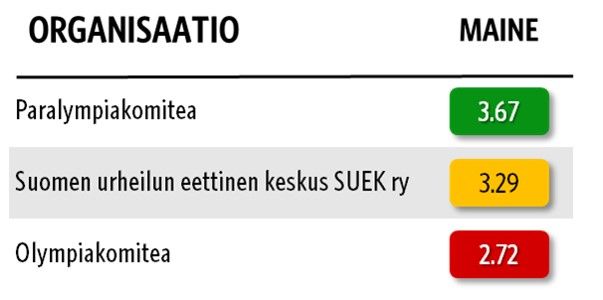
As in the previous year, the sports organization with the best reputation is the Paralympic Committee, whose reputation rose by 0.10 points from the previous year. The Finnish Center for Sports Ethics (SUEK) continues anseende moderately anseende : there was no change from last year.
“The Paralympic Committee’s good reputation reflects the steady work the federation does to promote the status and recognition of para sports. Positive stories about athletes and success at the Paralympics also increase interest in and appreciation for the committee,” Laakso says with delight.
The Olympic Committee’s reputation is at a low point – “a poor reputation can set off a vicious cycle”
The Olympic Committee saw the sharpest decline in its reputation score compared to the previous year. The largest declines occurred in the areas of the Olympic Committee’s products and services, as well as its leadership.
Nina Laakso cites the Paris Olympics—where Finland failed to win a medal at the Summer Games for the first time—as the factors presumably behind the decline in popularity, as well as, in particular, the events and widespread discussions that followed the Olympics.
“The results indicate that, in the eyes of the public, the Olympic Committee and its leadership have not, on the whole, succeeded in their strategic tasks. The Olympic Committee does not have the public’s support for its current activities. In last year’s survey, the Olympic Committee was even experiencing an upward trend anseende various anseende . Compared to that, the decline in reputation can be considered highly significant in the bigger picture,” Laakso assessed.
“A decline in reputation can trigger a problematic cycle. As the share of public funding decreases, the need for private funding naturally increases. However, companies often shy away from commercial partnerships with organizations that have a poor reputation in order to avoid potential direct or indirect reputational risks. Furthermore, partnering with an organization that has a poor reputation does not yield the image benefits that are typically expected from such a partnership,” Laakso continues.
“This is also clearly evident in the stakeholder support surveyed. Both trust and interest in applying for jobs at the Olympic Committee have declined significantly. The low level of trust and the extremely low level of crisis resilience suggest that the organization’s partners tend to distance themselves during crises.”
The Floorball Federation Has the Best Reputation Among Sports Federations – The Ice Hockey Federation’s Reputation Continues to Decline
As in the previous year, the Floorball Federation is the sports federation with the best reputation in the survey. The second-most reputable federation, the Gymnastics Federation, is the biggest climber in the entire survey.
“The Gymnastics Federation is a pleasant surprise in our study. In addition to an improvement in its governance rating, the ratings for the federation’s products and services, as well as its sustainability practices, rose significantly from last year. The influence of the Gymnastics Federation’s new board chair may already be evident behind anseende . Furthermore, the sport has not experienced any unethical incidents during the year that would have negatively affected its reputation, such as the cases related to coaching or healthy lifestyles among young people that came to light in previous years,” says Laakso.
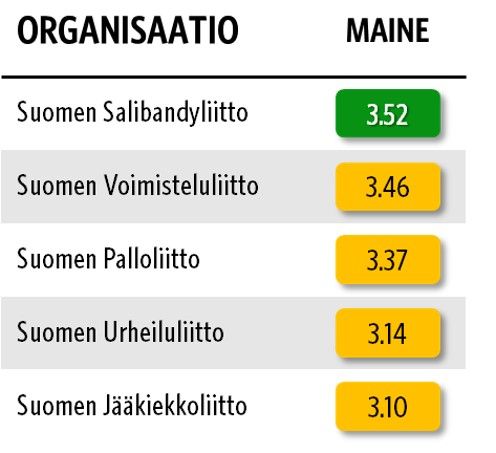
The sports federation that has seen the biggest decline in popularity is the Finnish Ice Hockey Association, whose reputation among the public has continued to decline, just as it did last year.
anseende the Finnish Ice Hockey Association’s anseende , the greatest decline has occurred in its image as an employer. The image as an employer has the strongest correlation with the level of support the public shows toward the Finnish Ice Hockey Association. This highlights the strong significance of the association’s role as an employer as a factor influencing the public’s behavior,” says Laakso.
The reputations of the Football Association and the Sports Federation also declined compared to the previous year.
“During her term, Riikka Pakarinen, president of the Sports Federation, has, among other things, taken on a role that involves responding quickly to social issues related to sports. However, the Sports Federation’s reputation does not seem to be responding positively to the president’s public profile. Pakarinen has successfully and actively taken on the role typically reserved for the leaders of service organizations on several different issues.”
This is how we conducted the study
T-Media’s “ Reputation&Trust 2024” survey of sports organizations and federations examined the reputation of Finnish organizations among the general public. The study examined three Finnish sports service organizations: the Finnish Olympic Committee, the Finnish Paralympic Committee, and the Finnish Center for Sports Ethics (SUEK). From among the sports federations, the five that received the most general subsidies in 2024 were selected for the survey: the Finnish Ice Hockey Association, the Finnish Football Association, the Finnish Floorball Federation, the Finnish Sports Federation, and the Finnish Gymnastics Federation.
The reputation of sports organizations was measured using the “ Reputation&Trust ” research model, which evaluates reputation based on eight factors: governance, finances, leadership, innovation, engagement, products & services, workplace, and responsibility.
Data for the study was collected via an online survey between August 30 and September 18, 2024. A total of 3,342 Finns participated in the study. The analyses of sports organizations are based on more than 1,600 validated organizational evaluations.
The study’s target group consisted of Finns aged 15–65 nationwide (excluding the Åland Islands). The sample was weighted to be representative of the population by gender, age, and region of residence. The margin of error for the entire data set is at most approximately 1.70 percentage points in either direction.
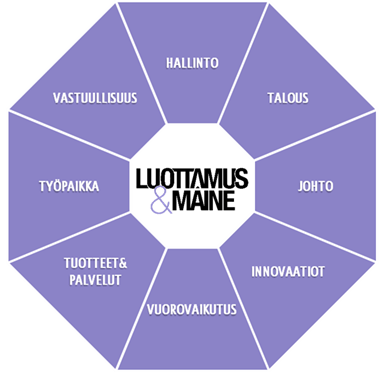
Reputation&TrustIn this research model, an organization’s reputation is assessed based on eight factors: governance, finance, leadership, innovation, interaction, products & services, workplace, and corporate responsibility. The organization’s reputation score is the average of these factors.