Riku Ruokolahti: The Process of Knowledge-Based Management
“Today’s plans are tomorrow’s reality.”
First, you learn to recognize what you don't know
We’re still at Jätti Yhtiö Oyj, and you’re still at the helm. Yesterday was a thought-provoking day: you and the executive team reached a consensus on the company’s reputation, its significance, and its specific impacts. After the impact analysis, I was left with the feeling that, for once, we were all on the same page.
But many things still left me wondering. We only discussed the general public, its significance, and impact analyses. What about other stakeholders? Customer satisfaction seems to be at a pretty good level, so the processes for customer service and products are probably in order. But what do those customers really think of us and what we do? How do factors outside the service process affect us?
We have a carefully built network of influencers and strong personal relationships with political decision-makers and government officials. Competent people know the right people and are able to bring our ideas to the right places. But what do these influencers think of the employer of our lobbyists—that is, us, Giant Corporation, Inc.? And how does that affect the conditions necessary for the success of our advocacy work?
The situation with the media is somewhat similar. Our work is built on personal relationships, and we’re already measuring the effectiveness of our media communications. We have an idea of what journalists think of our company, but it isn’t based on data analysis that reveals the impact of our reputation. We serve the media effectively, as research shows, but the structure of our company’s reputation—and especially its impact—remains unknown. Is there a certain perception among journalists that negatively influences their interpretations?
Working with investors is in a critical phase right now. Of course, we’re focusing on producing and distributing financial information, as well as building relationships with institutional investors and analysts who specialize in our company. You’re really putting your all into this. The CFO and his team have organized a whirlwind tour of meetings across the globe. As the new CEO, you need to convince the markets of the company’s new direction and market Giant Corporation as an investment opportunity. Strategy is, of course, the focus of the discussion, but isn’t it true that the cooperation of the company’s stakeholders determines the success of our strategy—and the factor that determines that cooperation is our reputation?
Should we discuss the prerequisites for success in this context? And does the investment community itself have a clear consensus on what kind of company we are? Perhaps they’re projecting the prerequisites for the success of our strategy onto their own perceptions of us, and thus our reputation ends up affecting our stock price even in the short term. We really need to do something about this—and damn quickly.
What about us? Our employees are satisfied with their jobs, their salaries, and their immediate supervisors, but what do they really think about our company and what it does? If we were to gauge the company’s reputation among our own people, wouldn’t we get some kind of truth? Insights from the people who have the most hands-on experience with us. Does our own team think we conduct our business ethically? Do employees see the company as operating transparently or being well-managed? You don’t know if you even want to know this, but I suppose we have to. We certainly can’t just plow ahead with our eyes closed.
Now I’m feeling a little overwhelmed. There seems to be a lot to think about regarding reputation, but once you understand its significance, you really have to get a handle on the issue somehow. You decide to ask for help and consult an outside expert on what Jätti Yhtiö Oyj should do now. How do you take this issue from a state of contemplation to a state of action? Projects don’t create culture—but processes do!
It is true that there is a great deal to understand about an organization’s reputation and its specific effects. After all, it is the mark that you have left on your stakeholder environment through your actions—and you continue to leave that mark all the time.
But you have to start somewhere, and we’ve already made a start. Jätti Yhtiö Oyj has assessed and analyzed its current reputation and its impact on the general public. It is true that this stakeholder group is, in itself, indirect for Jätti Yhtiö Oyj, which operates as a B2B firm; however, it is nonetheless the “substance” and social system within which all of Jätti Yhtiö’s direct stakeholders operate. (See the chapter in this book titled “Positioning the Company in Relation to Stakeholders.”) From a holistic perspective, it is easiest to start with the general public, and it is precisely from the general public that one can obtain the best and most comparable overview of Jätti Yhtiö Oyj’s situation.
The company’s reputation among the general public was discussed extensively and carefully by the executive team. The analysis of the structure and impact of the company’s reputation already provided clear insights for corporate management. It turned out that Giant Company’s external employer image has an exceptionally strong impact on the company’s overall reputation and stakeholder support among the general public—stronger than any other factor. This led to a truly fascinating discussion about the gaps between the company’s day-to-day reality and its employer brand.
The conclusion that emerged from the findings and the discussion was that this cannot be addressed through external communications alone; rather, we must also make genuine operational changes and investments in human resources management. In addition, we will begin communicating Jätti Yhtiö’s role in society through employer branding initiatives.
In addition to the above, we have launched a process aimed at improving our understanding of our interactive dimension.
Service automation processes aimed at cost competitiveness have turned our once-great company into an interaction partner as warm as an answering machine. There were already hints of this in customer satisfaction surveys, but it seems this is also evident among the general public in two ways. The level of awareness is very low, and on the other hand, clear evidence of the impact of this perception was obtained from an impact analysis. We’re already off to a good start here: measure, analyze, make an impact!
We’ve just reviewed the general public’s input, but what’s next? Hurry, hurry! In reality, measuring a single key stakeholder group and understanding its impact takes up a significant portion of the management team’s mental bandwidth—especially in the early stages—and there’s only so much shared time and capacity to go around. And reputation is never the only thing a company needs to manage. Giant Corporation managed to turn this idea into action exceptionally quickly. In real life, issues may linger on the table and in various working groups for quite some time before decisions are made and resources are allocated.
We have found that the best practice is to break things down into smaller parts and revisit them regularly. In practice, this means that it is often neither appropriate nor sensible to measure and analyze all stakeholders at the same time. Organizations simply do not have the capacity to address all issues simultaneously.
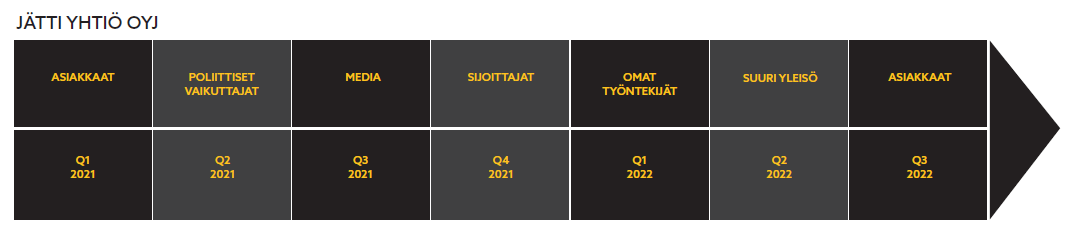
When a huge number of measurements and analyses are carried out as a single massive project, a vast amount of reputation-related issues are addressed all at once, and then they aren’t revisited for a long time. What happens is that there’s such a flood of issues, data, and draft decisions all at once that it’s impossible to take it all in. For this reason, we’ve found that it often makes sense not to rush. Better results come when you focus on the process, not the project. Generate information regularly at a pace that allows you to process it with ease, so that the big picture is constantly being filled in. For a large company, this kind of arrangement could mean, for example, applying a reputation model to one key stakeholder group each quarter.
Let’s return to the reflections in the first few paragraphs of this chapter. By following the approach outlined above, you’ll find profound answers to your questions within a year. To the impatient, that may sound like a long time, but is there really a shortcut to happiness? It always takes time to get a handle on things, and you have quite a lot going on right now anyway—and surely tomorrow as well.
Once a quarter, you take a moment to review your reputation analytics and analyze one stakeholder group in light of previous data. Your understanding of the situation becomes more complete, and your plans take on new nuances. You begin to gain experience from your actions and their effects.
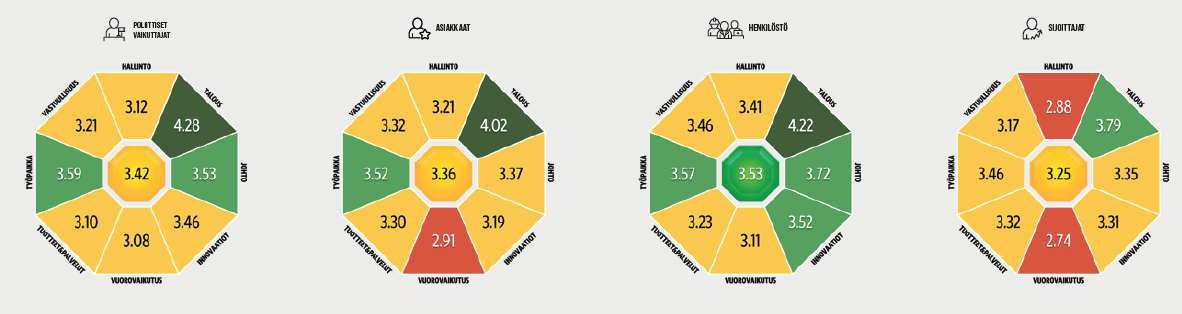
Just over a year has passed. Your core team is now familiar with Jätti Yhtiö Oyj’s reputation and its influence among key stakeholders. It has become clear that the stakeholders are closely related to one another. The footprint of the reputation is similar across different stakeholder groups, even though its size varies among them. Impact analyses also yield similar results across different stakeholder groups, even though the structure of the reputation varies. Comparison and discussion are possible—and downright easy—because standardized tools have been applied to everything! We know the structures of the reputation and its impacts like the back of our hands.
There are management challenges, but you’re somewhat relieved. The same priorities for development and communication work quite well across all stakeholder groups. There’s no need for the company to be completely different in different areas. One great Jätti Yhtiö Oyj works! It’s worth noting here that Jätti Yhtiö’s situation isn’t, in itself, a happy exception. The common thread among stakeholders that facilitates management and strategy can almost always be found in impact analyses.
There has been regular discussion on the matter, and the topic often comes up in other meetings as well. Performance is also discussed in terms of reputation, and impact analyses are cited. Alongside your systematic work, almost without realizing it, you notice that reputation-based thinking is becoming integrated into your entire management approach. And expertise and culture continue to spread throughout the organization. Soon, everyone will be interested in the recent developments in Giant Corporation’s reputation and the impact of its ongoing projects.
Otherwise, when will the next survey be conducted among such-and-such a stakeholder group? This in itself has a huge impact. You get what you measure, and today’s plans are tomorrow’s reality. It won’t be long before this way of thinking becomes part of your corporate culture. Without even realizing it, you’ll start taking reputational considerations into account in a completely different way in all discussions, decision-making, and even in the actions of individuals. New impact analyses are eagerly awaited.
It’s hard to imagine when you don’t know. In a few years, you won’t have just been responsible for Jätti Yhtiö’s competitiveness and leadership. You’ll have transformed your entire management culture. You’ll be masters of proactive, data-driven leadership. Your experience and evolved way of thinking might save Giant Corporation from a national reputation crisis before anything even starts to happen—because nothing will start to happen. At some point in the chain of future decisions, things will go completely differently than originally planned. Without even realizing it, you have steered Giant Corporation, Inc. toward an alternative future—a better future.
Riku Ruokolahti has written a handbook on corporate reputation and its management. The chapter published here, “The Process of Knowledge-Based Management,” can be found in the handbook’s second section: “Systematic Reputation Management.”
[button url=”/trust-reputation/” size=”btn-md” style=”btn-primary” target=””]Learn more Reputation&Trust[/button] [button url=”https://reptrust.com/maineen-johtamisen-kasikirja-tilaus/” size=”btn-md” style=”btn-secondary” target=””]Order the handbook[/button]