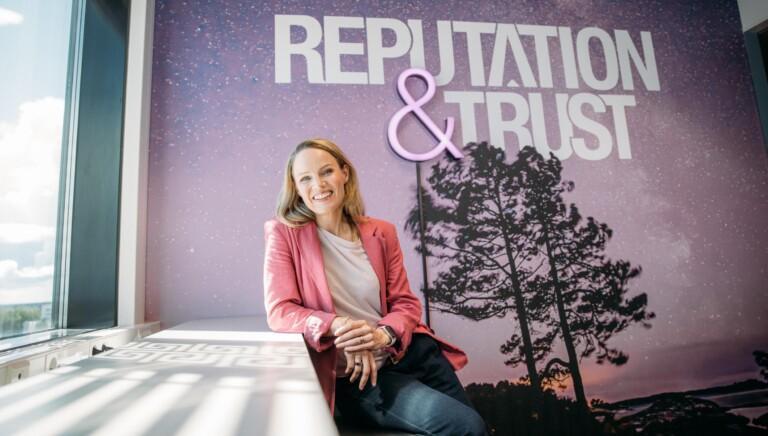
Sari Lounasmeri and Victor Snellman, CEOs of the Finnish Foundation for Share Promotion and the Finnish Shareholders’ Association: “Investing is a matter of trust”
Reputation&Trust In a special episode of *Akademia*, Sari Lounasmeri, CEO of the Finnish Stock Exchange Foundation, and Victor Snellman, CEO of the Finnish Shareholders' Association, discuss the importance of reputation for publicly traded companies.
“Listed companies should take an interest in their reputation, because, after all, investing is a matter of trust,” says Sari Lounasmeri, CEO of the Finnish Stock Exchange Foundation.
“Trust is largely based on a company’s reputation; investment decisions are influenced by many factors that are linked to that reputation.”
“Reputation is a matter of trust, where promises must be kept month after month, week after week, and day after day,” adds Victor Snellman, CEO of Suomen Osakesäästäjät.
Lounasmeri and Snellman emphasize that anseende is not about quick wins but rather long-term, consistent effort. anseende be solid so that it can weather setbacks and secure financing quickly, for example, in a crisis.
A recent example of a crisis that has affected many companies is the COVID-19 pandemic.
“By the time a company needs financing quickly, it’s too late to start building its reputation. It needs to be in good shape by the time it enters the market,” Lounasmeri emphasizes.
“Individual investors increasingly value transparency and openness in business operations and pay attention to whether a company acts in accordance with its values.”
A good reputation benefits a company's management in many ways
Snellman considers it a positive sign that the management and board of a publicly traded company are also shareholders. This builds trust and credibility for both investors and management itself.
“I would like to see management and the board of directors own as many shares as possible in the company they lead,” Snellman says.
“This means they need to be particularly interested in the company’s reputation. After all, it’s more pleasant to lead a company with a good reputation than one with a bad one.”
According to Snellman, commitment also reflects pride in one’s work and community. Even if a company currently has a poor reputation among investors, it is possible to improve that reputation, and doing so is a great achievement.
“Then we can say that we’ve accomplished this together with management, the board, and the employees.”
Lounasmeri agrees with Snellman.
“The company’s good reputation is something that unites and engages management, the entire staff, and shareholders. There is a large group of people who hope anseende , and who care about it and are proud of it,” Lounasmeri notes.
The large number of individual investors is creating pressure anseende
Private investing has surged in popularity recently, and there are now more Finnish stockholders than ever before.
The growth in the number of retail investors relative to institutional investors is changing the dynamics of the financial markets. According to Lounasmeri, direct ownership increases interest in what companies are doing. This interest also places greater demands on a company’s reputation.
“More than 900,000 Finns already own publicly traded stocks. An increasing number of people are interested in becoming shareholders and building wealth. When you own even just one share, you follow the company in a whole different way,” says Lounasmeri.
For publicly traded companies, the growing number of potential investors also means a need for more diverse stakeholder communication and pressure to build the company’s reputation as a good investment opportunity among a broader audience.
“We used to think it was enough to just reach out to large investors—who are few in number and easy to meet with. Now we have a large group of potential shareholders and investors. It’s a great opportunity, but it’s impossible to contact them individually. They get their information from various sources, and that’s how our reputation is built in their eyes,” Lounasmeri notes.
Snellman says that, as a rule, individual investors are the group that generates information on the stock market and drives trading in a company’s shares. Active trading also determines a company’s market capitalization.
“People are more eager to buy shares in a company with a good reputation, which often means they’re also willing to pay more for them. In other words, people are willing to pay a premium for a good reputation,” Snellman summarizes.
“Studies conducted during the pandemic have also shown that anseende of a company’s value anseende has increased. In major indices, slightly more than one-third of a company’s value is determined anseende .”
Comparable data on companies' reputations is needed
In a rapidly changing business environment, there is a need for new types of metrics that investors can use to evaluate companies. Predicting a company’s future using traditional methods, such as historical data, becomes more difficult when, for example, the performance of the entire industry is uncertain.
“In times of change, a certain kind of ‘knockout competition’ unfolds more quickly. New winners and new losers emerge. In such situations, reputation may be a more reliable way to evaluate companies than, for example, financial figures, which can fluctuate rapidly,” says Lounasmeri.
“When it comes to financial performance, it’s very easy to compare companies with one another. The metrics are comparable, and investors are very familiar with them. On the other hand, when it comes to anseende, brand, corporate responsibility, and other abstract concepts, the challenge is that while investors are increasingly interested in these factors, it is difficult to obtain comparable data on them.”
Every individual investor has their own perception of a company and its reputation, but according to Snellman, it is also important to obtain information about what other investors think of companies and their reputations. A company’s dividend and earnings per share are absolute and indisputable figures, but when it comes to reputation, the collective perception of a large group of investors provides a better understanding of it.
“I believe that a consensus among a large group of respondents creates measurability and comparability between companies and, in the long term, contributes to anseende company’s anseende . Here, perhaps, the collective wisdom generated by individual investors also reveals insights about an individual portfolio manager at the aggregate level: what they might think about anseende on a company’s value—and, by extension, whether a stock is overvalued or undervalued,” Snellman muses.
“It’s really interesting to see what retail investors think about the reputations of different companies and what factors genuinely influence those reputations. What are the factors a company can influence if it wants to improve its reputation among retail investors?” Lounasmeri notes.
Text: Tuuli Pohjola, Video: Vesa Koivunen
The mission of theFinnish Stock Exchange Foundationis to promote securities savings and the securities markets in Finland. Suomen Osakesäästäjät is a nationwide investors’ association whose purpose is to help Finns build wealth. We have launched a research collaboration with the Finnish Stock Exchange Foundation and the Finnish Stock Savers to study the reputation of publicly traded companies among individual investors. Reputation&TrustThe study, conducted using the [model], will provide information on, among other things,, how retail investors perceive a publicly traded company, the level of willingness among retail investors to collaborate with a publicly traded company, and what are the key factors driving this willingness to cooperate, which listed companies can use to increase, among other things, retail investors’ willingness to invest.
Please get in touch—I'd be happy to tell you more about our new special research project!

HANNA-MARI AULA,SENIOR SPECIALIST
Hanna-Mari focuses on analytics-based anseende consulting. Hanna-Mari has 20 years of experience in research and reputation management. She has previously worked at the KAUTE Foundation and Pohjoisranta, as well as in research at Aalto and Stanford.
[button url=”/academy/” size=”btn-md” style=”btn-primary” target=””]View other Academy episodes[/button] [button url=”/subscribe-to-newsletter/” size=”btn-md” style=”btn-secondary” class=”align-right” target=””]Subscribe to the Academy newsletter[/button]